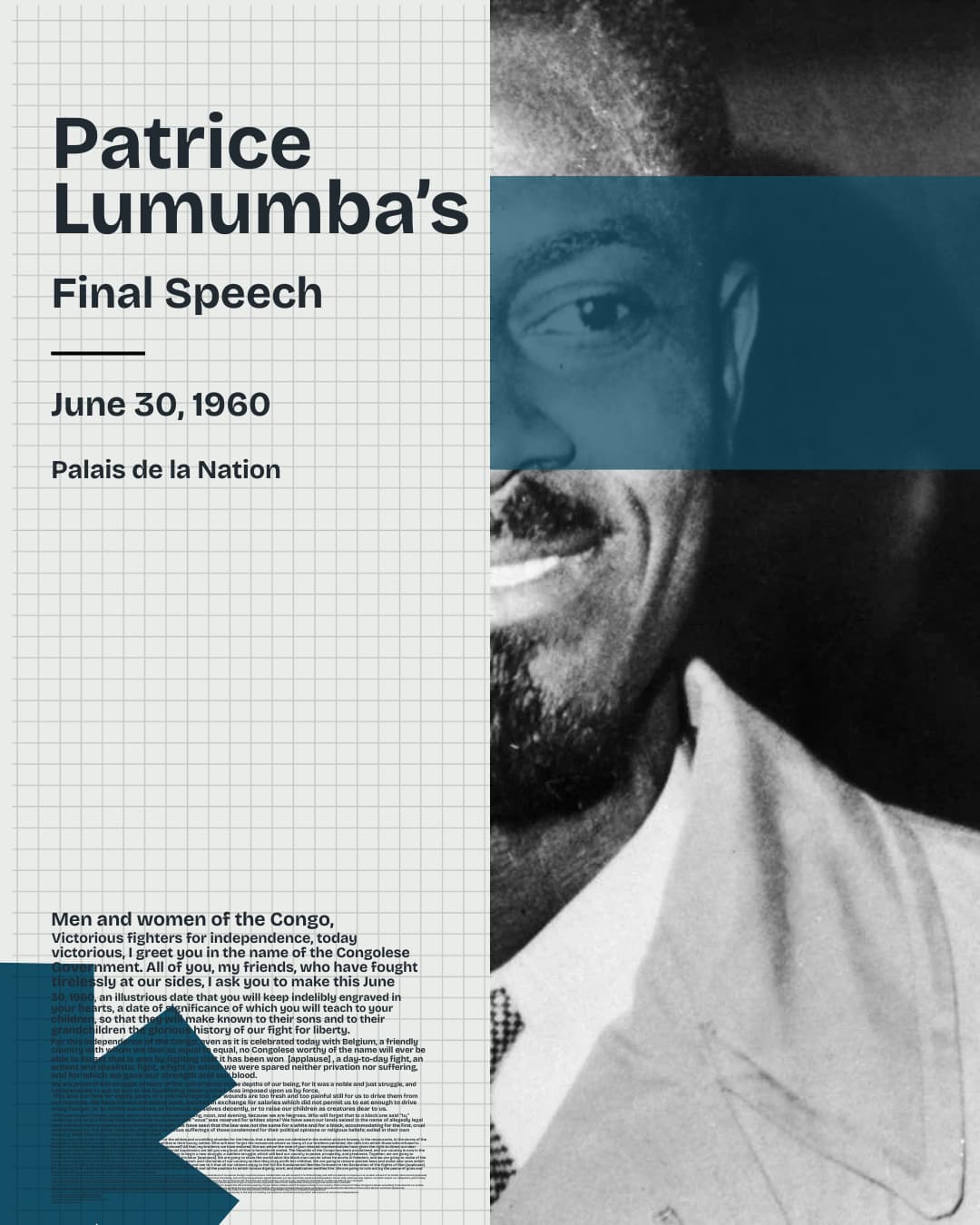
After decades of colonial control, Congo finally elected its first democratic leader, Patrice Lumumba. Six months later, he was dead.
He wasn’t a warlord, a gangster or a nepotistic implant. He was a common man and a proud member of the working class. In another world, he could have lived a long life on a quiet farm, following in his father’s footsteps. Instead, he fell in love with an idealistic vision of an independent Congo, free from imperial control. This vision led him to the world of politics and ultimately to his demise.
To his people, he embodied the warmth of a long-lost friend. His charming influence swelled the hearts of the Congolese public, who for years yearned for freedom and statehood. While his pan-African ideals made him popular within his country, on the outside, he was making enemies in powerful places. His defiant leadership was quickly attracting the malice of Belgian officials, frustrated presidents and even the CIA.
From Postal Clerk to Political Leader
Isaïe Tasumbu Tawosa was born on July 2, 1925, and later became the pan-Africanist martyr known as Patrice Emery Lumumba.
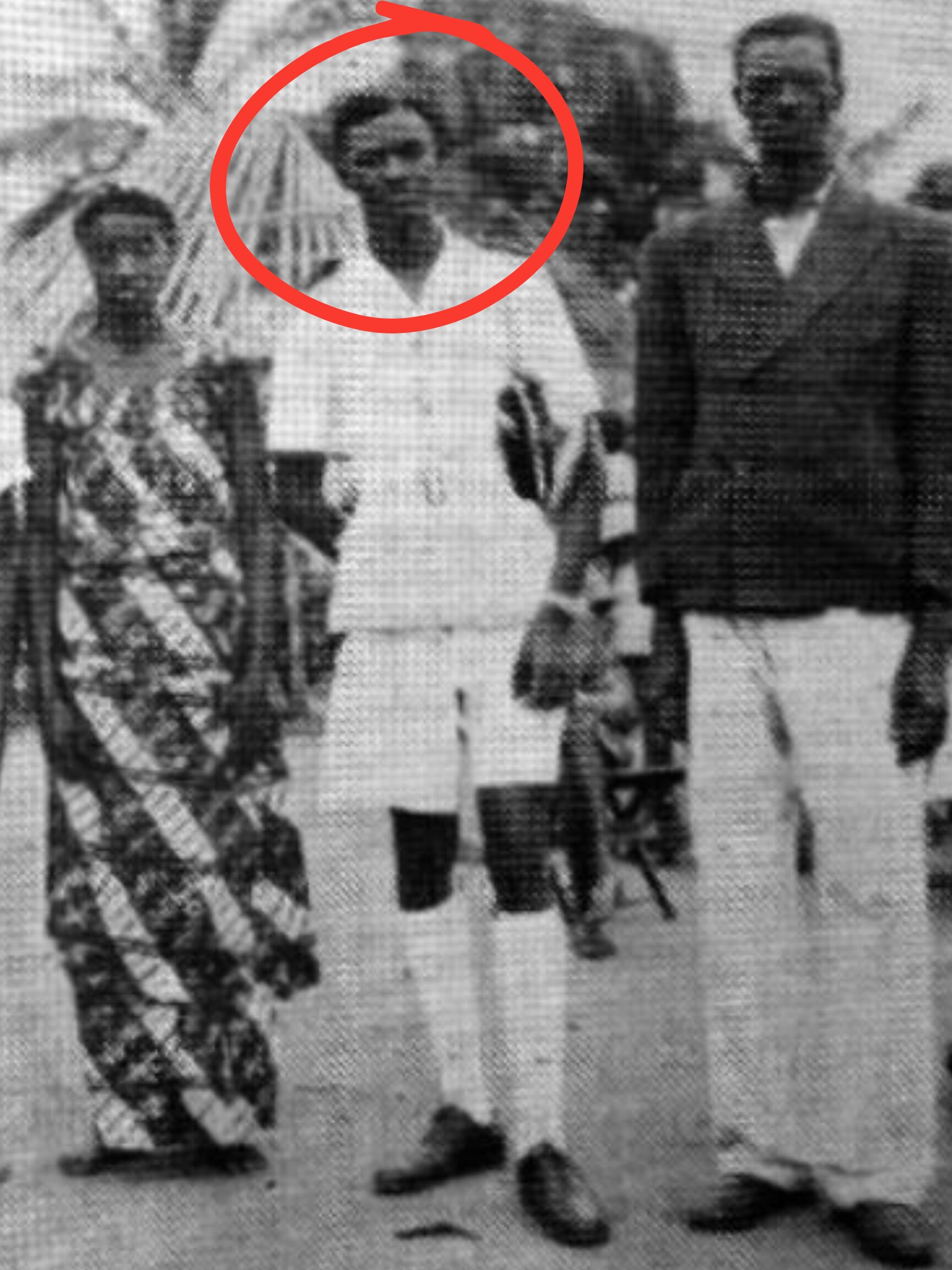
Despite his farming family roots, he carved out his own path towards anticolonialism and politics. After years of working at the post office, he found an outlet for his anti-imperialist views by co-founding the political group, Mouvement National Congolais. Following a messy period of politicking and an extremely close call, Lumumba and the MNC gained enough support across the country. In June 1960, he became the prime minister of the Democratic Republic of the Congo.
On a micro level, he wanted his people to be free from racial subjugation. In a wider sense, he also wanted African nations to have a fair chance to develop themselves into a strong political bloc. Lumumba had ideas of a truly autonomous Africa, where the continent would have full control over its resources and trade policies.
June 30, 1960, should have been a joyous celebration, officially marking Congo’s independence from Belgium. Instead, Lumumba’s speech exposed the perils of the past and present. When he stood at the podium and delivered words of defiance and calls for justice, the West effectively earmarked his execution.
June 30, 1960: Target Acquired
On Independence Day, King Baudouin of Belgium gave a speech that praised his country for righteously saving Congo from its own destruction. He commented on how King Leopold II “civilized” the nation and banished all the tribal conflicts the region faced before European intervention. His speech very closely mimicked an outdated rhetoric known as the white man’s burden. This term originates from Rudyard Kipling’s poem of the same name. In it, Kipling proudly stated that it was the European duty to parent other races due to his beliefs of white superiority.
Many Europeans at the time treated other groups, especially Africans, as both children and devils alike. They viewed colonization as a necessary responsibility to show non-Europeans the ‘proper’ way to be good citizens. This rhetoric often leaves out the violence that accompanies colonialism. In his speech, King Baudouin exclaimed that Belgium saved Congo from the Trans-Atlantic slave trade but failed to mention the millions forced into slavery under the orders of his own great-uncle, Leopold II.
In front of a large crowd, the King proudly expressed that Belgium entered Congo to bring peace and modernity to its people. I suppose he forgot about the mass murders, the human zoos…the amputations.

With every word of his speech, Baudouin effectively buried the horrors of his country’s crimes. At the same time, he expected the Congolese people to thank him for granting their freedom. After the King’s speech, it was Lumumba’s turn to set the story straight. No one had scheduled Lumumba to speak that day, yet he delivered a moving speech that remains relevant to geopolitical events happening at this very moment.
In his declamation, Lumumba called out the injustices of the Belgian regime. He reframed the King’s approach by reminding Belgium that they did not give Congo freedom, his people demanded it.
He exposed the racism, the forced labour and the suffering. He proclaimed that the treatment his people received under Belgian rule was worse than death.
Lumumba shared his plans of Congo having full control over its resources, operating in its own interests and expelling all foreigners who could not learn to coexist. The Congolese attendees excitedly applauded Lumumba’s speech. Their cheers erupted so loudly that he had to pause and restart several times. The people loved it. Baudouin was not happy.
Immediately after the speech, everything came crumbling down. Baudouin furiously marched out, which stalled the ceremony for an hour. The mainstream Western media labelled Lumumba as an ungrateful radical, while black members of the Congolese army mutinied because Lumumba didn’t immediately give them promotions. Making matters worse, key regions such as Katanga were so displeased with Lumumba that they seceded and turned away from the country. Katanga was Congo’s wealthiest province and contained the very resources Lumumba mentioned in his speech. Without access to those resources, the country could not support itself financially and faced an enormous uphill battle.
The mutiny from the Congolese army caused mass violence, which the Belgians used to reinforce their presence in Katanga. They seized this opening to support anyone who went against the Lumumba government. This rapid instability would place another target on the prime minister’s back.
Uncle Sam and the Three-Lettered Boogeyman
After the Independence Day speech, the Western world quickly picked sides. It was no surprise that their allegiance leaned more towards Belgium than to Lumumba. When he asked for help to properly handle the mutinies and secessions, they said no. His leadership was quickly unravelling, and with very few allies to turn to, Lumumba found refuge in an unlikely place. He turned to the East and accepted weapons from the Soviet Union, which only deepened the hole his speech had put him in.
The United States was now convinced Lumumba had been seduced by the red scent of communism. Larry Devlin, a CIA agent stationed in Congo, routinely reported back to headquarters with exaggerated tales of the prime minister turning the country into a communist foothold. Lumumba was no communist. He was pragmatic. He was desperately trying to fix things as they were breaking, but unfortunately, the damage was irreparable.
Belgium hated him for rubbing their noses in its past brutality. America hated him for cozying up to the communists, despite refusing to help him in the first place. Soon, these two world powers turned their petty gossiping into a real objective to eliminate Patrice Lumumba, and thus, Project Wizard was born.
Congo’s Julius Caesar
Project Wizard was a covert CIA operation supported by Belgium and aimed at destabilizing the Lumumba government. The CIA, Devlin in particular, did not find random conspirators to use as puppets in this plot. He focused on the men who stood beside Lumumba on that fateful Independence Day.

Joseph Kasavubu and Joseph Mobutu both knew and worked alongside Lumumba, yet they needed very little nudging to turn their colleague into a sacrificial lamb. With American bribes sitting heavy in their pockets, they stripped Lumumba of his position and dismissed him from government on Sept. 5, 1960.
This did not change the people’s opinion. So long as he was alive, his advocates loudly supported him. On Nov. 27, 1960, he successfully escaped in an attempt to reach his support base in Stanleyville, but was recaptured shortly after. To break his spirit, Mobutu sent him to the “home territory of his sworn enemy,” the state of Katanga.
In Katanga, he was tortured, beaten, led to a remote area and shot in a field of tall grass on Jan. 17, 1961. His body was dismembered and dissolved in acid in an attempt to quite literally remove all traces of him.

Lumumba: A Modern-Day Martyr
Despite this attempt at erasure, Patrice Lumumba remains vibrant in the minds of the Congolese. So too does the struggle for resources. The global forces that puppeteered Project Wizard continue to destabilize the region for copper and cobalt.
Whenever I come across current-day stories of the horrors happening in the DRC, my mind wanders back to Lumumba. What if he served his entire term? What if his friends refused those bribes? Where would Congo be today?
The patterns found in his downfall are not unique. The ’60s, ’70s and ’80s were rife with tales of secret missions that destabilized entire countries. Cuba, Guyana, Grenada and Jamaica. Similar stories can be found throughout the Global South. In most cases, Western governments did not intervene to oust wicked warlords or to ‘spread democracy.’ They got involved to secure their own profits and remain in control of their prized colonies. As colonization began to dissolve, a new era of covert imperialism emerged. Western nations now use underground missions to ensure the continuation of a system that benefits their interests.
We must consider this when viewing the developments happening in central and western Africa today. When reading stories of civil wars and unrest, we have to investigate to find the powers behind the curtain. This is not to say that the West is always involved, but historical events are cyclical. It is safe to argue that the events of Jan. 17, 1961, altered Congo’s natural progression. A possibility of hope was quickly extinguished, and unfortunately, the stars misaligned for Patrice Lumumba.
Everything that could have gone wrong went wrong. Belgium’s sensitivity, Cold War fears, hysteria, CIA bribes and jealous friends all coalesced and turned a once-loved and respected leader into public enemy no. 1. So many questions remain when discussing Lumumba’s untimely death. But one thing is certain: Congo was robbed of a great leader.
